
The other night, as a family, we headed over to our local church building so my wife could practice the piano for an upcoming performance. Walking into the church with the kids, I knew that the window for them getting bored and grumpy was small. If I didn’t find a way to entertain them quickly enough, they would get upset, and it would be borderline impossible to recover.
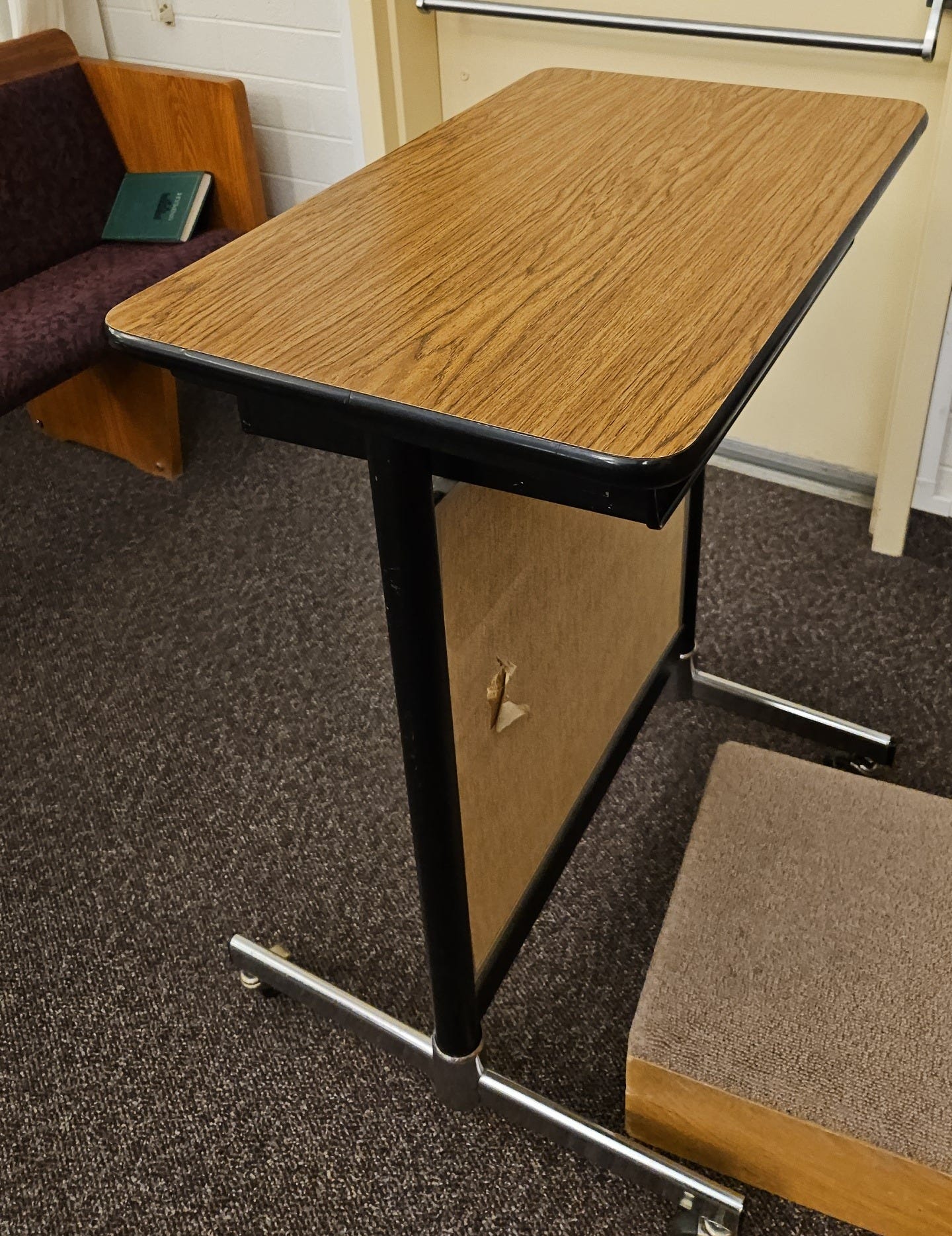
With this in mind, we walked into the church, and I saw a small podium and a stool; it hit me that those two items created a very simple yet effective store. I stood behind the podium and said, “Hello, everyone, and welcome to my store. What would you like to purchase today?”
Immediately, my kids were intrigued.
They took turns coming up to the store and asking to buy different things, exchanging them for pretend money, and also taking turns as the shopkeeper. We played this game for almost two hours as my wife practiced for her performance.
And what’s funny is that, in the moment, it felt like I had just stumbled into a way to keep my kids entertained while we waited, but the more I’ve thought about it, the more I realize this is the part that we as parents sometimes forget: play is not just fluff.
The American Academy of Pediatrics views play as a vital component that supports healthy development and strengthens parent-child relationships, a significant assertion given that, on the surface, it appears to be simply children being silly.
So yes, in that moment, I needed a way to keep my kids from melting down in a church building, but what was also happening was that we were connecting in a way that is actually really meaningful, and they were getting to do the kind of work kids naturally do through play.
Imaginative play is something we often hear about from parenting experts, and it can sometimes start to feel like one more thing we’re supposed to do, but there are real reasons it matters.
Pretend play is often linked to skills such as self-control, working memory, and flexible thinking, which are essential for helping kids navigate real life. And you can see that even in a simple game like playing store, because they are waiting for turns, following role rules, and dealing with little pretend problems like “we’re out of bananas” or “the credit card machine broke.”
But even if you ignore every study, you can still see what’s happening right in front of you. Because your kid is practicing being a human in a low-stakes world, and you’re building a connection while they do it.
However, as adults, we often find ourselves at a loss because we are so out of practice, which makes it difficult for us to figure it out.
What we often forget in the moment is that kids have incredible imaginations.
They don’t need you to create an intricate storyline or build a whole imaginary world. They just need one simple idea and a starting point, and they can build it into something amazing.
Much like we trust doctors to give us advice about our health, we can trust our kids to lead imaginative play. They are the experts, and as adults who are out of practice, we need to lean on their expertise to lead us through imaginative play.
In this post, I aim to demonstrate why imaginative play is often easier than we think. I’ll also give you a simple, practical on-ramp for starting in the moment without overthinking it, so your kids can do what they already know how to do, and you can step into it with them.
Why most dads freeze up during pretend play
If I’m being honest, the hardest part of imaginative play is not coming up with an idea.
It’s starting.
Because many of us find ourselves in the same spot: we want to play, our kids want us to play, and when the moment comes, we draw a blank and get lost before we even begin.
Not because we don’t care, or because we’re boring. But because we’re out of practice.
Most adults are trained to be efficient and put together. We’re used to doing things with a purpose and doing them “the right way.” We’re used to being able to explain what we’re doing and why we’re doing it.
Imaginative play is the opposite.
It’s inefficient on purpose. It doesn’t always make sense and can often feel a little ridiculous.
And if you haven’t done it in a long time, it’s not surprising that it feels awkward. It’s like showing up to a sport you haven’t played since middle school. You remember that you used to know how to do it, but the second you try, everything feels slow and clunky.
And it’s in that moment of feeling awkward that we begin to feel discouraged.
It’s easy to fall into the trap of trying it once, only to feel awkward, and your kid gets bored, walking away. You tell yourself, “Well, I tried,” and then you give up, hoping to try again next time.
And don’t get me wrong, I’m not judging any dad who falls into this cycle. It is easy to fall into because it happens to all of us. Myself included. Yes, I found success this time at the church, but that is just one moment out of probably 10 other tries that failed. I’m re-learning how to do this, just like each of you is.
However, something important to remember is that most of the time, your kid walking away isn’t a sign that you've failed. It’s just part of how kids play. They bounce around, test ideas, and they get distracted. And honestly, a lot of times they’re also watching you. They’re seeing if you’re actually going to stay in it for a minute, or if you’re going to quit the second it feels uncomfortable.
They aren’t bored as much as they aren’t sure if you are into it as much as they are. Because the truth is, they don’t care what they are playing; all they care about is whether or not you are going to play with them.
So, how then do we prep ourselves to be ready when the time comes to play?
First, we need to change our mindset.
You’re not bad at imaginative play. You’re rusty.
And rust comes off way faster than you think. Especially if you stop putting pressure on yourself to be impressive. Your kid doesn’t need you to create some intricate storyline or build a whole imaginary world. They just need you to step into the first simple idea and let them do what they already know how to do.
Kids don’t need us to be creative geniuses. They need us to be willing.
Three simple steps for imaginative play
Here’s the simplest way I know to think about imaginative play when you’re in the moment and don’t have time to overthink it. Because the goal here is not to become some kind of “imaginative play dad” who always has an idea ready to go, the goal is just to have a dead-simple on-ramp you can use anytime your kid is standing there looking at you, waiting for you to start.
I call it the 30-second on-ramp, and it’s basically three steps.
First, notice a prop
And when I say prop, I mean anything, because it could be a podium and a stool like it was for us, or it could be a blanket, a cardboard box, a stick, a random grocery receipt, a paper towel roll, a couch cushion, or literally anything else that happens to be nearby.
Kids do not need the “right” toy; they just need something that can become something else.
Second, name the world
And this is where a lot of us get stuck because we feel like we need to explain the whole game or set up some intricate storyline, but you don’t; you just need one sentence, because the sentence is the doorway into the game, and once you say it, your kid will fill in the rest.
Here are some ideas you could use:
“Welcome to the store.”
“This is our spaceship.”
“Shh, we’re in a dinosaur museum.”
“We’re at a restaurant, and you’re the chef.”
Remember, the point is not to be clever; the point is to make it real enough that your kid can jump in.
Third, start the loop
This is the part that makes the whole thing work. Because once you have the prop and you’ve named the world, you just need a basic action you can repeat, so you give your kid a role, and you give yourself a problem, and then you repeat the same simple thing over and over until your kid complicates it.
So, if it's a “store,” your kid is the shopkeeper, and your problem is that you need to buy something. You walk up, ask to buy something, they give it to you, you ask how much it costs, you pay them, and you do it again. The repetition is not boring to kids; it’s the whole reason the game gets good, because the repetition gives them room to experiment, iterate, and try new ideas inside a structure that already makes sense.
And the best part is that if you do these three steps, you don’t have to carry the whole game on your shoulders. Because once you start the loop, your kid will almost always take it somewhere, and your job becomes a lot simpler, because you’re not trying to invent the world, you’re just staying in it long enough for them to build it.
How to kick off imaginative play without begging, bribing, or overexplaining
One of the biggest things that helps imaginative play actually happen, especially when you’re tired, or you’re in a public place, or you’re just not feeling super creative, is this simple principle: don’t ask, just play.
Because I think a lot of us as parents try to be polite about it, so we’ll say something like, “Do you want to play store?” or “Do you want to play pretend?” and it sounds like the right approach. But the problem is that the second you ask, you turn play into a decision. And decisions invite “no,” even when your kid would have happily played if you had just started.
Another reason asking can backfire is that starting is the hardest part. Not just for us, but for kids too, because kids usually have a million ideas in their heads, but they don’t always know how to get the game going, and they also don’t always want the pressure of being the one to initiate it. So when you start the game for them, it’s like you’re giving them something to step into instead of putting them on the spot to decide.
So instead of asking, you just go straight into it, and you make it obvious that you’re willing to be silly, willing to commit, and willing to lead for the first ten seconds, because that’s usually all it takes for your kid to jump in and take over.
Here are a few ready-to-go opening lines you can use anywhere, because the more you have these in your back pocket, the easier it is to start without overthinking it:
“Quick, I need help. The store is open, and I forgot what we sell.”
“Attention everyone. The train is leaving in ten seconds.”
“I’m the customer. You’re the expert. Please save me.”
“Welcome to my restaurant. I will be complaining politely the entire time.”
“Oh no. A dragon moved into the living room.”
And once you start using the “don’t ask, just play” approach, you realize something pretty quickly: you don’t actually need a lot of creativity to make this work. You just need a few dependable starting points that you can pull out when your brain is tired, and your kid is standing there waiting.
Because that’s the real issue most of the time. It’s not that you don’t want to play, it’s that you can’t think of what to do fast enough, and then the moment passes.
So here’s a quick cheat sheet you can use this week. Something you can glance at and immediately have an idea you can try in under ten seconds.
A) Props that do all the work
Blanket = cape / tent / ocean
Chair = bus / horse / rocket
Box = mailbox / oven / treasure chest
Paper = menu / map / ticket / “official paperwork”
B) The easiest games to repeat
Store
Restaurant
Doctor’s office
Airport
Post office
Fix-it shop
C) Over-Arching Rule
If you can explain the game in one sentence, it’s probably perfect.
The real goal of imaginative play is showing up and letting your kid lead
When I think back on that night at the church, what still makes me laugh is how little it took. It was a podium and a stool.
That’s it.
There wasn’t some elaborate setup, there wasn’t a plan, and there definitely wasn’t a perfect storyline. It was just a couple of random pieces of furniture that happened to be in the right place at the right time, and the second we treated them like a store, my kids took it from there.
And that’s really the point I hope you'll take away after reading this.
Imagination is already in your kids. It’s not something you have to install in them, nor is it something you have to build from scratch for them. Your job is just to open the door, step through it with them, and stay there long enough for them to do what they already know how to do.
So if you try this this week, I’d love to hear how it goes, because I know every family has their own version of the podium and stool, where something random becomes the start of a game that you never would have planned.
What’s the most random object your kid has turned into something else?
Or if you already have a go-to, what’s your family’s easiest pretend game?
Imaginative play doesn’t need to be impressive, and it doesn’t need to look like what you think it’s supposed to look like. Most of the time, it looks like a random object, a weird voice, and a kid who’s thrilled that you’re actually in it with them. That’s the win.
So if you’re feeling stuck, don’t wait for inspiration. Use what’s already around you, and let your kid do what they already do best.