
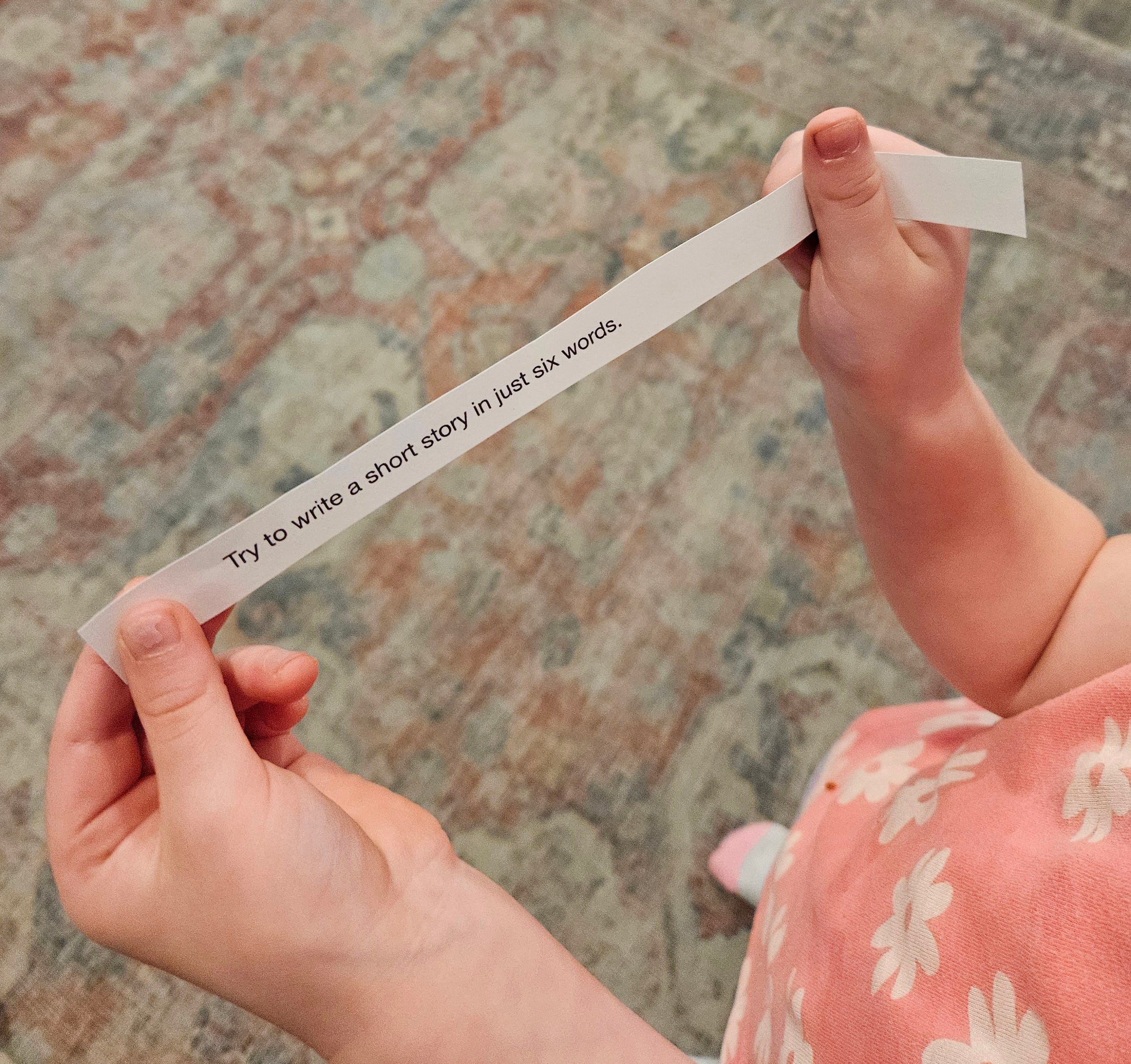
A little while ago, I was cleaning up the kitchen after dinner when I heard the familiar sound of tiny hands rummaging through a container in the living room. I poked my head around the corner. My five-year-old was standing on her tiptoes, pulling a folded slip of paper from an old deodorant box on the shelf. She unfolded it carefully, squinted at the words, then looked up at me.
“Dad, this one says ‘try to write a story in just six words.’”
She didn’t ask for a screen. She didn’t whine. She didn’t even come to me first. She just walked over to the table, took out a piece of paper and a pencil, and started writing.
Here’s the thing. I hadn’t touched that box in months. Life got busy, the blog went on pause, and I honestly forgot it was there. But my five-year-old didn’t. She knew exactly where it was, exactly how it worked, and exactly what to do with it. I wrote about that moment a few weeks ago, not because it was some big parenting victory. But because this dumb little box of paper scraps had become a real thing in our house, quietly doing its job even when I wasn’t paying attention.
That box is what I call The Boredom Box. And if you’ve been reading this blog for any amount of time, you’ve probably heard me mention it. I’ve referenced it in multiple posts, and it has become the backbone of The Screen-Free Dad. But I’ve never actually sat down and given it the full treatment: what it is, how to build one, how to fill it, and (most importantly) how to make sure it doesn’t end up collecting dust in a closet.
That’s what this post is.
A complete guide to The Boredom Box.
So let’s get into it.
What is a Boredom Box?
A Boredom Box is a physical container, a jar, a shoebox, a bowl, a bag, whatever you have, filled with slips of paper that each list a single screen-free activity. When your kid says, “I’m bored,” they pull a slip and do whatever it says. That’s it. No app. No decision fatigue. No Googling “things to do with kids” while your child melts down in the background.
What makes it work is almost embarrassingly simple. It relieves you of the burden of decision-making in the moment.
When your kid hits you with “I’m booooored” at 4:30 on a Tuesday, your brain is not at its creative best. The Boredom Box takes that pressure off and gives your kid a sense of agency (they get to pull the slip), a hit of surprise (they don’t know what they’ll get), and a concrete next step that replaces the reflex to reach for a screen.
Why boredom is not the enemy (and why a Boredom Box is not about avoiding it)
Before we get into the how-to, I want to address something that might seem like a contradiction. If I’m handing you a box designed to cure boredom, doesn’t that mean I think boredom is bad?
No. Actually, the opposite.
Boredom is one of the most underrated gifts you can give your kid. I know that sounds ridiculous, but the more I’ve dug into the research, the more I’ve realized that the “I’m bored” moment is not a problem to solve but rather an opportunity in disguise.
A 2014 study published in the Creativity Research Journal by Dr. Sandi Mann and Rebekah Cadman found that people who performed boring tasks before being given a creative challenge produced significantly more creative solutions than a control group. The researchers found that daydreaming acted as a bridge between boredom and creativity. Basically, when your brain has nothing to do, it starts wandering, and that wandering is where creative thinking flourishes.
Dr. Teresa Belton at the University of East Anglia has been studying this specifically in kids. Her research found that boredom is essential for developing what she calls “internal stimulus,” the kind of inner drive that leads to genuine creativity. She interviewed writers, artists, and scientists who all pointed to childhood boredom as a critical part of their creative development. Even more interesting: her earlier work showed that children in communities without television scored significantly higher on imaginative thinking than kids with TV access.
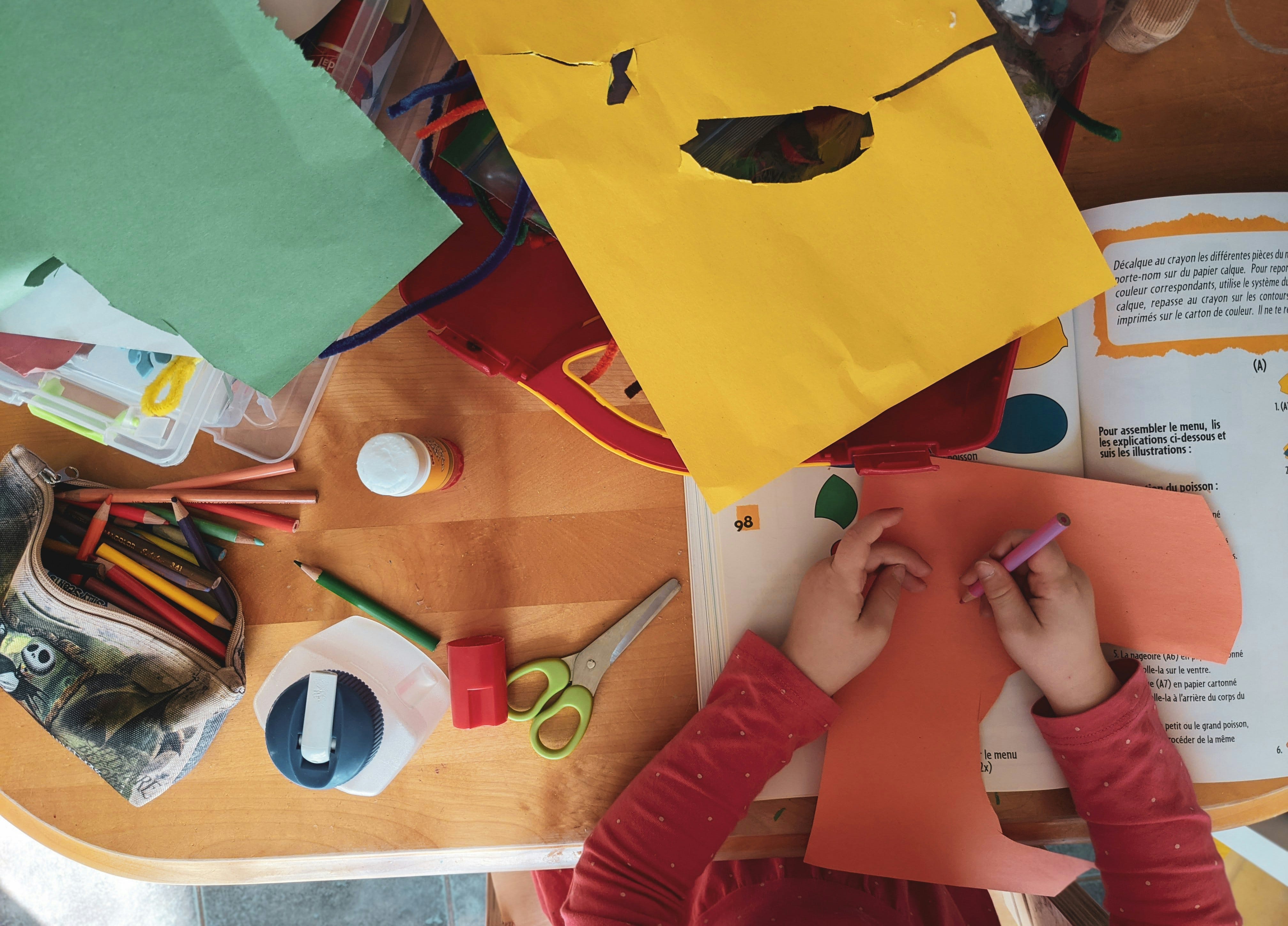
What I’ve learned is that boredom helps children develop planning skills, problem-solving abilities, frustration tolerance, and self-esteem. When kids have to figure out how to spend their time, they learn to make plans, gather materials, and work through problems on their own.
I wrote about this in The Hidden Cost of Screen Time: the real issue with screens isn’t what they show our kids. It’s what they replace. And one of the biggest things they replace is this exact kind of unstructured, self-directed play that arises from boredom.
The Boredom Box is not about eliminating boredom. It’s about giving kids a launchpad when they’re stuck. Think of it as a bridge between “I’m bored” and self-directed play. The slip gets them started. What happens next is up to them.
My five-year-old, for example, has pulled a slip that said “draw a picture” and ended up spending 45 minutes building an elaborate art studio out of couch cushions. The slip was just the spark.
Dr. Jamie Jirout at the University of Virginia backs this up. Her research suggests that providing structure to unstructured time, such as giving a starting point rather than leaving kids completely at a loss, actually fosters deeper engagement.
Kids who have the agency to choose their own path are more motivated and develop skills that over-structured activities can’t provide.
That’s exactly what the Boredom Box does. It gives your kids just enough structure to get started, while still leaving enough room for creative decision-making.
How to build a Boredom Box (step by step)
Building a boredom box for kids takes about 20 to 30 minutes. You don’t need to block out an entire afternoon or Saturday morning. You can do it tonight before you put the kids to bed.
Here are the steps:
Find a container: A mason jar, a shoebox, a cereal box, or even a mixing bowl. It genuinely does not matter. Ours is an old deodorant box. If your kid wants to decorate it, great. If not, a plain box works just as well.
Grab paper, scissors, and a pen: Regular printer paper, cut into strips. Nothing fancy. If you’ve got colored paper, go for it. If not, white is fine. This is not a Pinterest project.
Write one activity per slip: Keep prompts specific. “Build a fort with couch cushions and blankets” works better than “Build something.” More on what to write in the next section.
Fold the slips and drop them in: Part of the magic is not knowing what activity you’re going to pull.
Put the box somewhere visible: Not in a closet. Not on a high shelf. Somewhere, your kid can see it and reach it without asking for help. Ours sits on a low shelf in the living room, right next to the books.
Involve your kids: Both our five-year-old and our two-year-old helped come up with activities. Our five-year-old even wrote some of the slips (with a lot of creative spelling). That gave them ownership over the box, which I think is a big part of why they still use it months later.
And honestly? That’s it. Six steps, and you probably already have everything you need in a kitchen drawer right now.
Now, I know what you might be thinking: I love the idea, but I do not want to sit here and brainstorm 200 activities from scratch. I get it. That’s the part that stops most people.
To save you the brainstorming step, I put together a free guide with 200+ pre-written prompts you can print, cut, and drop straight into your box. Download the free Boredom Box guide here:
What to put in your Boredom Box
This is the question everyone asks, and honestly, it’s the most difficult one to answer. Because realistically, you can put anything you want in your boredom box. And I’m not trying to dodge the question or anything, because it’s really 100% open-ended.
My one piece of advice is to be specific. It’s easy to get into a rut of writing a bunch of generic activity ideas, but I promise you that if you spend the time now writing out specific and creative ideas, your boredom box will be a lot more successful.
To get you started, here are some activity ideas you can use:
Active and outdoor prompts
These get kids moving and burning energy. Think:
Set up an obstacle course in the backyard using whatever you can find
Draw a hopscotch board on the sidewalk with chalk and play 10 rounds
Go on a nature scavenger hunt (find something rough, something smooth, something red)
Have a dance party to three songs in a row
Play freeze tag in the yard
Creative and craft prompts
These involve making something. They don’t need to be elaborate:
Paint rocks and hide them in the front yard for neighbors to find
Build the tallest tower you can with blocks, then draw a picture of it
Make a card for someone in the family
Create a puppet out of a paper bag and put on a show
Draw a map of an imaginary island
Imagination and pretend play prompts
These spark storytelling and role play:
Open a pretend restaurant and take everyone’s order
Put on a talent show for the family (acts must be at least 30 seconds long)
Pretend you’re a scientist and do an experiment with water and food coloring
Create an imaginary world and tell Dad three rules about how it works
Set up a stuffed animal school and teach them something you know
Quiet and independent prompts
For low-energy moments, rainy afternoons, or when you just need 20 minutes:
Pick a book and read (or look at the pictures) for 15 minutes
Do a puzzle
Listen to a kids’ audiobook or podcast episode
Write a letter to Grandma (or draw a picture for her)
Sort your stuffed animals by size, then by color, then by how much you love them
Family and connection prompts
These are the ones designed for together time:
Cook something together (pick a recipe with three ingredients or fewer)
Play a board game or card game
Go for a walk around the block and count how many dogs you see
Have an indoor picnic on a blanket in the living room
Tell each other your favorite memory from this week
What happens when it doesn’t work
I’d be lying if I said the Boredom Box works perfectly every time because it doesn’t. Let me be honest about that.
Sometimes my five-year-old pulls a slip, and the activity completely bombs. The puppet show lasts 90 seconds. The nature walk turns into a tantrum because she wanted to go the other direction. The “build a tower” prompt falls apart, literally, and she’s in tears. That happens.
Sometimes the box sits on the shelf for a week, and nobody touches it. Life gets hectic, routines shift, and the box becomes invisible even when it’s right there. I’ve had stretches where I forgot about it, too, and the screens crept back in as the default.
And sometimes, on the hard days, a screen is just the right call. Your kids are sick or overtired, and the box is right there, but you still reach for the remote instead. And that’s okay. That is genuinely okay.
The Boredom Box is about having a system in place so that most of the time, when the “I’m bored” moment hits, you have something to reach for that isn’t a screen.
The goal is progress, and progress means some days the box saves the afternoon and some days it doesn’t. Both are fine.
If you’re still wrestling with all-or-nothing thinking about screen time, this piece on mindset shifts is worth a read.
Start Tonight
Let me bring this back to where we started. A five-year-old girl standing on her tiptoes, pulling a folded slip of paper from an old deodorant, completely unprompted, on a random Tuesday evening. No fanfare. No parenting win of the year. Just a small, quiet moment where a simple system did exactly what it was built to do.
The Boredom Box won't transform your family overnight, nor will it eliminate screens or guarantee that your kids never whine again. But it will give you something to point to when the “I’m bored” hits. It will take the pressure off your brain in those exhausted, 4:30 p.m. moments. And if you give it a few weeks, it might just start running on its own.
You can build one tonight. Twenty minutes, some paper strips, a pen, and whatever container is sitting in your kitchen right now. That’s it.
And if you want to skip the brainstorming step, grab the free Boredom Box guide with 200+ pre-written activity prompts right here:
Print it, cut the slips, drop them in a box, and you’re done.
Then come back and tell me how it goes. I can’t wait to hear what your kid pulls first.
Love love love this! Can we add a link to this post to our website: https://www.screensense.org/more-irl-less-url
Maybe I should make one for myself too for that hour after the kids are in bed but I'm not yet and I should be doing something more productive than scrolling 😅.